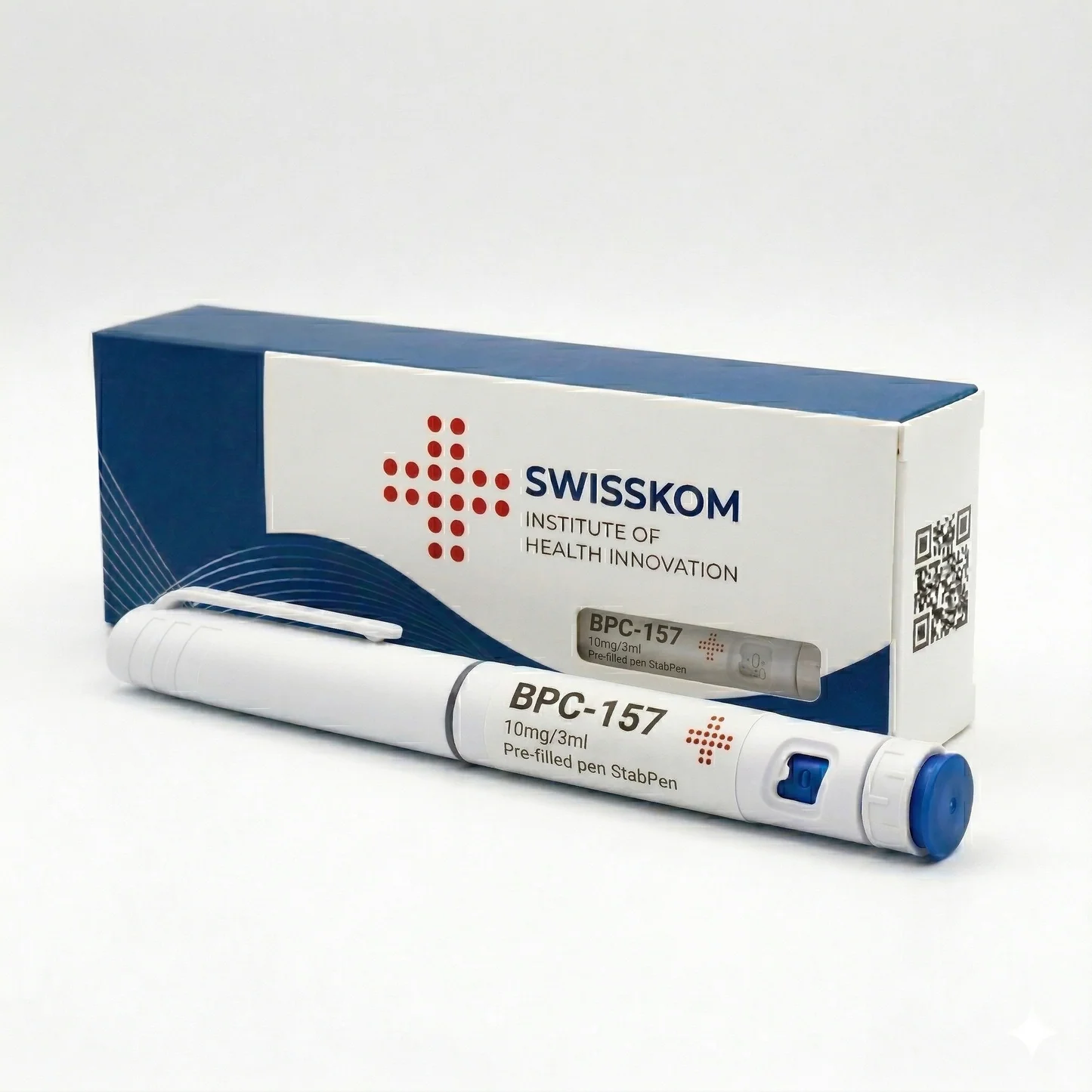
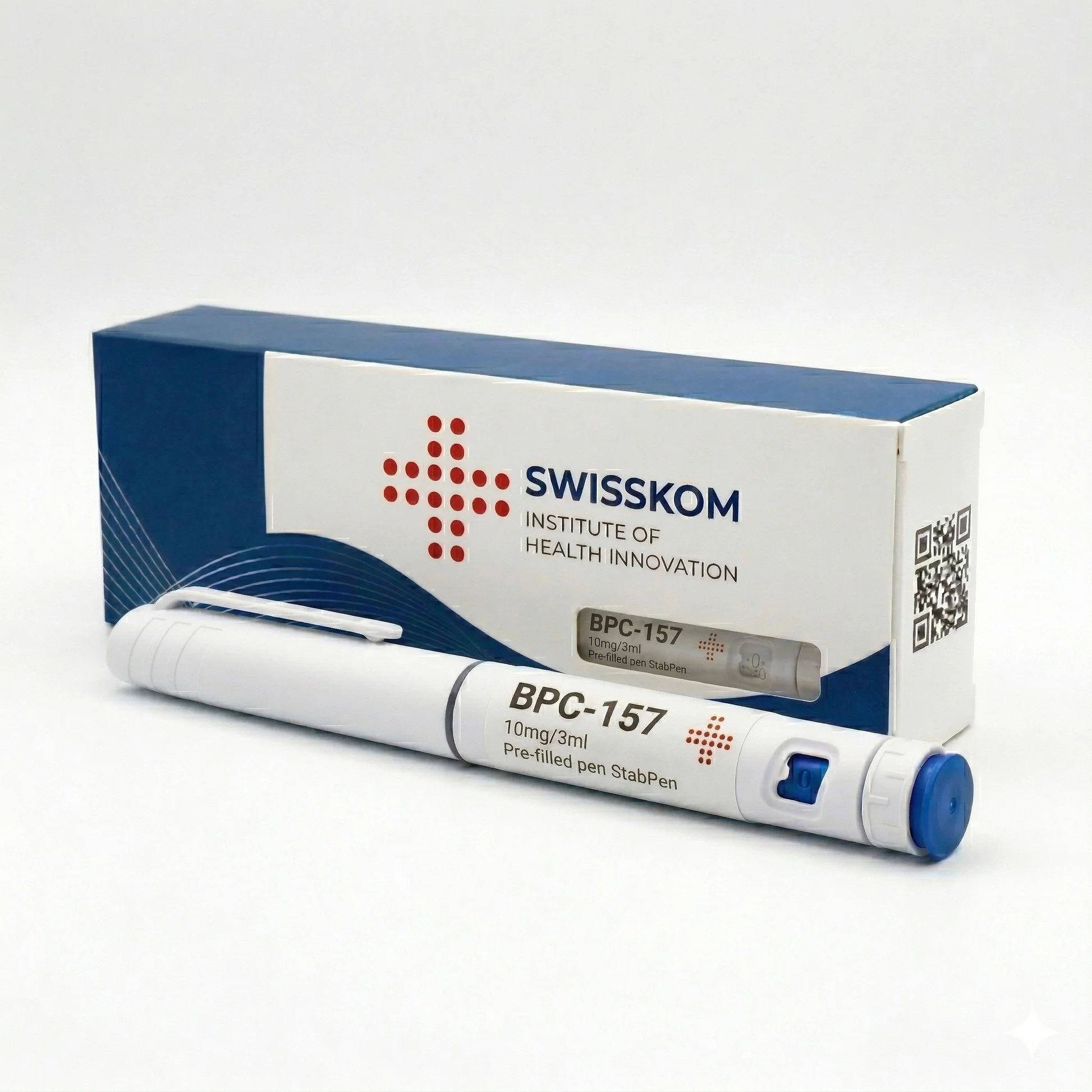
BPC-157 | 5mg/10mg
BPC-157 | 5mg/10mg
- 5mg
- 10mg
- StabPen™
- ≥99% Pure
In stock
Show full details
Tissue regeneration

Tendon and joints

Anti-inflammatory

Cardiovascular

Immune support

Cellular repair
BPC-157 is a synthetic pentadecapeptide derived from a protective protein in gastric juice. One of the most studied reparative compounds in the preclinical literature with documented effects on connective tissue, vascular remodeling and modulation of inflammatory cascades.
DOSAGE
- Preloaded StabPen™ with calibrated units
- Each 1 unit contains 50mcg of active substance
- 20 units equals 1mg
- Total Units: 100 at 5mg; 200 at 10 mg
MECHANISM OF ACTION
BPC-157 upregulates growth hormone receptor expression on fibroblasts and activates the FAK-paxillin pathway, promoting directed cell migration and angiogenesis. Modulates the NO-system and eicosanoid pathways, reducing pro-inflammatory signaling.
RESEARCH APPLICATIONS
- Tendon and ligament repair research
- Patterns of intestinal mucosal integrity
- Studies on angiogenesis and wound healing
- Modulation of the nitric oxide pathway
What is BPC-157?
BPC-157 (Body Protection Compound-157) is a synthetic pentadecapeptide composed of 15 amino acids, which is the subject of preclinical studies in the field of cell biology, tissue repair and gastrointestinal physiology.
Scientific interest in the compound stems from observations in experimental models examining its interactions with processes related to cell signaling, vascular function, and tissue response to injury.
BPC-157 differs from established drug therapies for tissue repair in that evidence of its effectiveness and safety in humans remains severely limited. Results from laboratory and animal models are not sufficient to draw conclusions about its clinical effectiveness.
In a research context, BPC-157 is being studied as an experimental compound, not as a proven treatment for trauma, joint problems, or digestive system diseases.
BPC-157 and tissue repair studies
Tissue repair is a complex biological process that involves interactions between cells, extracellular matrix, blood vessels, and various signaling molecules.
The preclinical literature for BPC-157 addresses potential interactions with several of these processes. The researchers evaluated parameters related to cell migration, vascular remodeling, and the organization of the tissue response to experimental injury.
These observations are scientifically interesting, but must be interpreted in the context of the model used, the experimental conditions, and the limitations of the respective study.
BPC-157 and tendons
Tendons are made up mostly of collagen fibers and have a specific structure that allows them to transmit mechanical forces between muscles and bones. Their recovery involves an inflammatory response, new matrix formation and ongoing remodeling.
In preclinical models, BPC-157 has been studied in relation to indicators of the structure and mechanical properties of damaged tendons. These studies can help formulate hypotheses about cellular mechanisms, but do not prove that the compound heals tendon injuries in humans.
BPC-157 and links
The connections stabilize the joints and are subjected to significant mechanical loads. Their biological repair depends on multiple factors, including blood supply, collagen organization, and the mechanical environment.
Studies on BPC-157 include experimental models of ligament damage. The results should be considered as preclinical data that cannot be automatically transferred to the treatment of sports injuries in humans.
BPC-157 and gastrointestinal physiology
The initial scientific interest in BPC-157 was also related to research into the defense mechanisms of the gastrointestinal mucosa.
In experimental models, the interactions of the compound with cellular protection, vascular responses and various mechanisms of tissue damage are studied. Publications in this field cover a variety of experimental conditions, so the results should not be generalized as proven efficacy in human gastrointestinal disease.
What is known about the mechanisms of action of BPC-157?
Preclinical studies address several signaling pathways potentially involved in the observed biological effects of BPC-157.
Among these are processes related to cell signaling, endothelial function, angiogenesis, and regulation of the inflammatory response. Some of the experimental literature also discusses signaling components such as FAK and paxillin.
It is important to note that the presence of an observed change in a signaling pathway does not automatically prove that it is the only mechanism of action or that the same effect will occur in humans.
Full characterization of the mechanism requires independent studies, reproducible results, and additional data on the pharmacokinetics, safety, and interactions of the compound.
BPC-157: preclinical data versus clinical evidence
In evaluating BPC-157, it is particularly important to distinguish between experimental results and evidence from quality clinical trials.
Type of evidence What it can show Cell models Interactions with certain cellular processes and signaling pathways Animal models Biological effects under specific experimental conditions Small human studies Preliminary observations limited by study size and design Randomized controlled trials More reliable assessment of efficacy and safety with appropriate design
A systematic review published in 2026 found only three human studies with a total of 30 participants and rated the certainty of the available evidence as very low. The authors conclude that the available data do not support clinical use outside of ethically approved and regulated high-quality clinical trials.
Therefore, BPC-157 remains an experimental compound. Preclinical results can be the basis for future scientific hypotheses, but do not constitute proof of established clinical benefit.
BPC-157 price: how to compare products?
Searching for "BPC 157 price" may result in offers with different quantities, formats and trade descriptions. These characteristics are not sufficient to establish whether two products are comparable in terms of quality or chemical identity.
When evaluating a research product, it is important to consider several factors:
- Quantity: Check that the specified 5 mg or 10 mg refers to the exactly identified compound.
- Certificate of Analysis: Check that the documentation refers to the specific lot.
- Analytical method: Find out how the declared purity is determined and what limitations the method has.
- Traceability: Check that the laboratory, lot and corresponding results are indicated.
- Format and storage: Assess whether the features are supported by product-specific documentation.
- Purpose: Distinguish investigational product from authorized medicinal product.
There is no reason to assume that a higher price guarantees higher quality or that a lower price necessarily means lower purity. A reliable assessment requires verifiable data, not just advertising claims.
Since BPC-157 is not an approved drug for general use, prices in independent online stores should not be presented as official prices of approved therapy.
What does HPLC and CoA mean at BPC-157?
HPLC (high performance liquid chromatography) is an analytical method used to separate and examine the components in a sample. Depending on the methodology used, it can provide information on the chromatographic profile and relative purity.
A CoA (Certificate of Analysis) is a certificate of analysis that presents the test results of a particular lot.
When evaluating documentation, it is important to distinguish between three issues:
- Is the identity of compound? confirmed
- How the declared purity is determined?
- What additional features have been verified and which remain undetermined?
A purity result of ≥99% does not in itself prove sterility, stability, absence of all possible impurities, or safety for human use. These features require appropriate methods and separate evidence.
Having a CoA is a useful piece of documentation, but it is not a substitute for an independent assessment of the product's quality and regulatory status.
RUO: what does research use? mean
RUO stands for Research Use Only — intended for research use only. The designation describes the stated purpose of the product, but does not in itself prove its quality and does not constitute an authorization for medical use.
Investigational products should not be presented as approved drugs just because the relevant molecule is described in the scientific literature.
With BPC-157, this distinction is particularly important because preclinical publications greatly outnumber qualitative human clinical data.
BPC-157 FAQ
What is BPC-157?
BPC-157 is a synthetic pentadecapeptide that is primarily studied in preclinical models of tissue injury, cell signaling, and gastrointestinal physiology.
What is the price of BPC-157?
The price depends on the specific product, the requested quantity, the format and the documentation. The advertised online price is not a proof of quality, authenticity or medical suitability.
Has BPC-157 been shown to repair tendons and joints in humans?
No. There are preclinical studies, but the available human clinical data is limited and of very low certainty. Clinical effectiveness for the treatment of tendon and joint injuries has not been established.
What does BPC-157 5 mg or 10 mg mean?
This is the claimed quantity of the product. It must be verified by appropriate documentation and does not constitute a recommendation for application or mode of use.
What proves purity ≥99%?
This is an analytical indicator, the interpretation of which depends on the method and method of calculation. By itself, it does not prove sterility, safety or effectiveness in humans.
Is BPC-157 approved for medical use?
BPC-157 is not an approved drug for general use. Available evidence does not support its clinical use outside of appropriately regulated clinical trials.
Conclusion
BPC-157 is an experimental peptide that has attracted scientific interest because of preclinical observations in the field of tissue repair and cell signaling. Despite the substantial preclinical literature, evidence of efficacy and safety in humans remains insufficient.
When searching for BPC-157 and comparing BPC-157 price, it is important to distinguish between scientific publications, analytical documentation and claims for a specific commercial product.
Swisskom provides information on the research context of BPC-157. The described mechanisms and preclinical observations do not constitute therapeutic claims or proof of clinical efficacy of a specific product.
| Composition | BPC-157 5mg/10mg per pen |
| Format | Pre-loaded StabPen™ Calibrated units |
| Cleanliness | ≥99% (HPLC verified) |
| Stabilization | StabPen™ SSS technology |
| Storage | 2–8°C (refrigerated) |
| Expiration date | As per CoA — typically 12 months |
| Molecular weight | 1,419.5 g/mol |
| CAS | 137525-51-0 |
References are provided for research context only. Swisskom makes no therapeutic claims.
1. Sikiric P et al. (2018). Stable Gastric Pentadecapeptide BPC 157. Curr Pharm Des. PMID: 296183002.
2. Chang CH et al. (2011). BPC 157 enhances tendon healing. J Appl Physiol. PMID: 216170833.
3. Gwyer D et al. (2019). BPC 157 and wound healing. Curr Pharm Des. PMID: 30854946
WHY STABBEN™?
Precision requires consistency at every step.
⚗️
01
SYNTHESIZED
The peptide was manufactured to ≥99% purity under pharmaceutical conditions. Identity was confirmed by HPLC and mass spectrometry.
🔒
02
STABILIZED
Dissolved in a proprietary SSS solvent. Maintains the tertiary structure of the peptide. Prevents oxidation, aggregation and denaturation.
💉
03
DELIVERED
Pre-loaded in a calibrated pen. Verified and calibrated doses. QC verification. CoA for each batch. Cold chain.
VERIFICATION OF PURITY
📋
DOWNLOAD COA (PDF)Certificate of Analysis
Lot-specific CoA available for download. Full data includes HPLC chromatogram, mass spectrometric confirmation and endotoxin results.
Frequently Asked Questions
What each StabPen™? contains
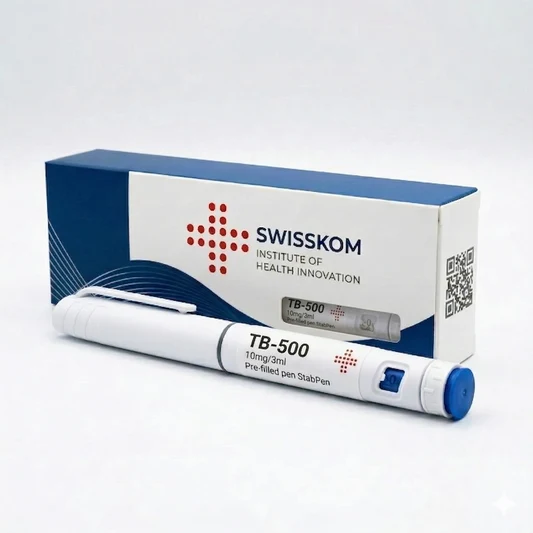
Each StabPen™ contains 10mg of BPC-157 dissolved in MSSPT stabilizing solvent, pre-loaded into a calibrated pen delivering 200 units (50µg per unit).
How is the peptide stabilized?
BPC-157 is dissolved in our proprietary MSSPT solvent, which maintains the peptide's tertiary structure and prevents degradation. No reconstitution required.
What are the storage requirements?
Store at 2–8°C in the original package. Do not freeze. Keep out of direct light. Shelf life — usually 12 months when refrigerated.
What does ≥98% purity mean?
Purity was measured by HPLC and confirmed by mass spectrometry. ≥98% means that at least 98% of the measured content is the target compound. CoA is available for each lot.
The researchers saw more
PEPTIDES FOR RECOVERY
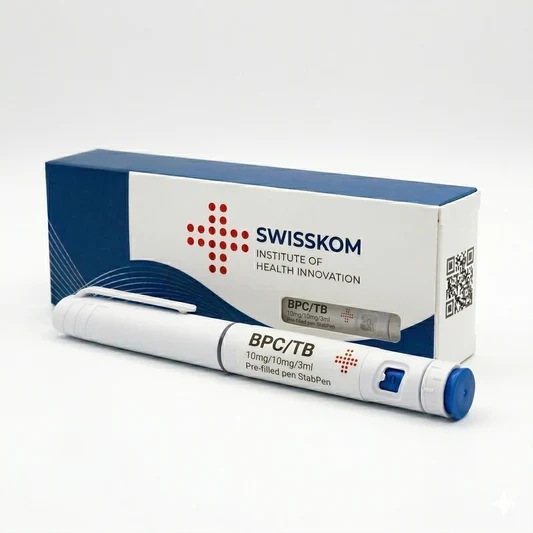
BPC-157 + TB-500 (Blend) | 5mg+5mg/10mg+10mg
A two-way compound for tissue repair. Synergistic angiogenesis and anti-inflammatory activity.
- 5mg
- 10mg
- StabPen™
- ≥99% Pure
Usual priceFrom €89,00Usual pricePEPTIDES FOR LONGEVITY
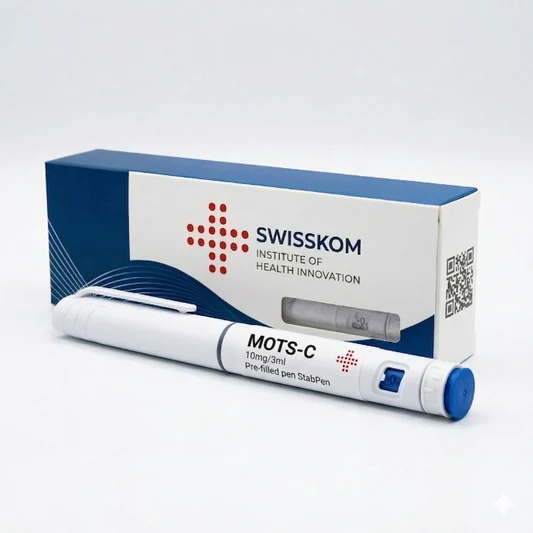
MOTS-c | 10mg/20mg
Mitochondrial peptide. A study of metabolic homeostasis and cellular stress response.
- 10mg
- 20mg
- StabPen™
- ≥99% Pure
Usual priceFrom €79,00Usual pricePEPTIDES FOR RECOVERY
TB 500 (Thymosin beta 4) 5mg/10mg
Thymosin Beta-4 fragment. Systemic tissue regeneration and anti-inflammatory research.
- 5mg
- 10mg
- StabPen™
- ≥99% Pure
Usual priceFrom €59,00Usual price
DISCLAIMER
This product is intended for in vitro research and laboratory use by qualified professionals only. It is not approved for use in humans or animals, is not a drug, and has not been evaluated by a regulatory authority. Swisskom Institute of Health Innovation makes no therapeutic claims. By purchasing, you confirm that you are a qualified researcher and will use this compound only for legitimate scientific research.